
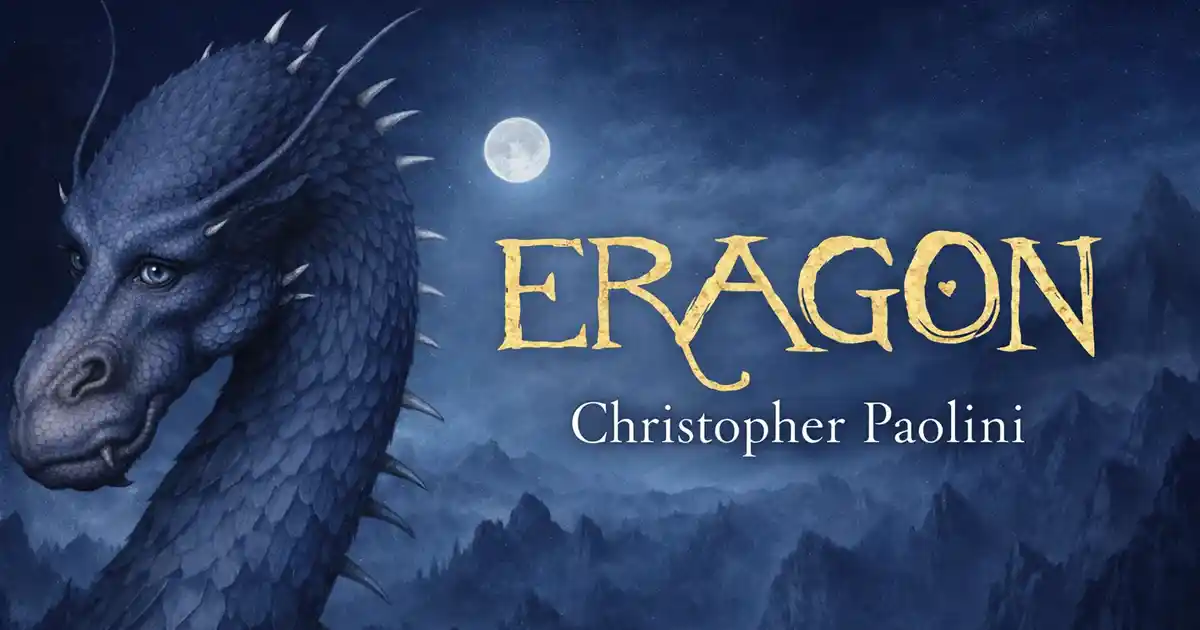
Few fantasy novels have sparked as much debate as Christopher Paolini's Eragon. Published in 2003 when its author was just nineteen (and written when he was fifteen), this dragon-rider epic became a publishing phenomenon; selling over 40 million copies worldwide, spawning a four-book cycle, a (widely maligned) film adaptation, and now a Disney+ television series in development. It's also one of the most divisive fantasy novels of its generation, inspiring fierce devotion and equally fierce criticism.
So which is it? A derivative pastiche of better stories, or a gateway drug to the fantasy genre that deserves its place on countless bookshelves? The honest answer is: both.

The Story
In the land of Alagaësia, fifteen-year-old Eragon is a poor farm boy living with his uncle Garrow and cousin Roran in the remote village of Carvahall. While hunting in the mysterious Spine mountains, he discovers a polished blue stone that turns out to be something far more valuable; a dragon egg.
When the egg hatches, revealing a brilliant blue dragon he names Saphira, Eragon's simple life shatters. The evil King Galbatorix; a former Dragon Rider who betrayed and destroyed his order a century ago; sends his monstrous servants, the Ra'zac, to retrieve the egg. They murder Eragon's uncle, burning down his farm and leaving him with nothing but a thirst for vengeance and a growing dragon.
With the help of Brom, the village storyteller who proves to be far more than he seems, Eragon embarks on a quest that will take him across Alagaësia. He must learn swordsmanship, master the ancient language of magic, evade the king's forces, and ultimately choose whether to join the Varden; the rebel alliance fighting to overthrow Galbatorix's tyrannical empire.
Along the way, he'll encounter elves, dwarves, witches, werecats, and a mysterious imprisoned elf woman named Arya who haunts his dreams. The fate of the world may rest in the hands of a farm boy and his dragon.
What Works
The Dragon-Rider Bond
The heart of Eragon is the telepathic bond between boy and dragon, and this is where Paolini genuinely succeeds. Saphira is more than a mount or a weapon; she's a fully realised character with her own personality, wisdom, and sardonic humour. She calls Eragon "little one" with maternal exasperation, offers counsel that cuts through his adolescent melodrama, and provides some of the book's most memorable moments.
Their relationship captures something primal about the dragon fantasy: the wish fulfilment of having a magnificent, powerful creature choose you, of sharing thoughts and soaring through skies together. For younger readers especially, this bond is genuinely magical.
The Worldbuilding
Paolini clearly loves the fantasy genre, and that enthusiasm shows in his detailed worldbuilding. Alagaësia is thoroughly mapped, with distinct regions, cultures, and histories. The ancient language magic system; where speaking something's true name gives you power over it; has internal logic and clear limitations. The history of the Dragon Riders, their betrayal, and the rise of Galbatorix provides a rich backdrop.
The author drew his maps himself, created multiple constructed languages, and researched everything from sword-forging to medieval travel times. For a teenager writing his first novel, the ambition is genuinely impressive.
The Gateway Effect
Perhaps Eragon's greatest achievement is one that's difficult to quantify: it made readers. Countless fans discovered their love of fantasy through this book. It arrived at the perfect moment; after Harry Potter had proven young readers would devour long fantasy novels, but before the YA market exploded; and served as a bridge to more complex fantasy for an entire generation.
There's real value in that. A book doesn't have to be literary art to be important; sometimes the most valuable thing a story can do is make someone want to read another story.
What Doesn't Work
The Derivative Problem
There's no gentle way to say this: Eragon borrows heavily from its predecessors. The plot follows Star Wars almost beat for beat: farm boy discovers he has a special destiny, his family is killed by the empire's servants, he's trained by a mysterious old mentor who turns out to be part of an ancient order his father belonged to, the mentor dies heroically, and he joins the rebellion to fight the evil emperor.
Meanwhile, the worldbuilding draws liberally from Tolkien: elves, dwarves, a dark lord, an ancient evil, even character names that echo Middle-earth (Eragon/Aragorn, Arya/Arwen). The magic system recalls Ursula K. Le Guin's Earthsea. The dragon-rider concept owes much to Anne McCaffrey's Pern.
Critics have called this plagiarism. That's too harsh; there's a difference between using genre conventions and copying. But Eragon rarely adds fresh perspective to its borrowed elements. It's comfort food fantasy, assembled from familiar ingredients without much innovation.
The Writing
Paolini was fifteen when he wrote this, and it shows. The prose is often overwrought, reaching for epic grandeur and landing on purple:
"Wind howled through the night, carrying a scent that would change the world."
That's the opening line. A scent that would change the world? It's trying very hard.
The writing improves as the book progresses; and improves significantly across the series; but Eragon frequently suffers from thesaurus abuse, clunky dialogue, and descriptions that tell rather than show. Experienced readers will find themselves wincing at adjective pileups and melodramatic pronouncements.
Character Depth
Eragon himself is a classic Chosen One protagonist, which means he's something of a blank slate. He's good at everything he tries (sword fighting, magic, languages), beloved by everyone he meets who isn't evil, and has few meaningful flaws. He exists primarily for readers to project themselves onto rather than as a fully realised character.
The supporting cast fares slightly better; Brom has genuine mystery and depth, Murtagh is intriguingly morally ambiguous; but many characters remain archetypes rather than people. The beautiful elf princess, the gruff dwarf, the wise mentor, the cackling villain: they're all present and correct, but rarely surprising.
Pacing Issues
The middle section of Eragon drags considerably. Paolini is clearly enamoured with his world and wants to show us every corner of it, but the travelogue sections; while teaching us about Alagaësia; slow the narrative momentum. The book could easily be a hundred pages shorter without losing anything essential.
The Controversy
Eragon has inspired genuinely heated debate. Detractors point to its derivative nature and argue it was only published because Paolini's parents ran a publishing company that initially released the book, and because novelist Carl Hiaasen's stepson happened to discover it and bring it to Knopf's attention. They see it as proof that connections matter more than quality.
Defenders counter that plenty of fantasy uses familiar tropes, that judging a teenager's first novel by adult standards is unfair, and that the book's enduring popularity proves it resonates with readers regardless of critical opinion.
Both sides have points. Eragon wouldn't have been published through traditional channels in its original form; it needed the unusual path it took. But millions of readers genuinely love it, and that love isn't invalidated by the book's flaws or its origin story.
The Series Context
The Inheritance Cycle:
Eragon (2003)
Eldest (2005)
Brisingr (2008)
Inheritance (2011)
Additional World of Eragon books:
The Fork, the Witch, and the Worm (2018) - short story collection
Murtagh (2023) - spinoff novel following Eragon's half-brother
The series was originally planned as a trilogy but expanded when Paolini realised book three needed to be split. Readers generally agree that Paolini's writing improves significantly across the series as he matures as an author, though the derivative elements remain throughout.
A Disney+ television adaptation is currently in development, with Paolini serving as co-writer and executive producer; a second chance after the critically panned 2006 film.
Who Should Read This?
Perfect for:
Younger readers (10-14) discovering fantasy for the first time
Dragon enthusiasts who haven't yet read extensively in the genre
Readers who enjoy comfort-food fantasy with familiar tropes
Those who loved the concept but hated the 2006 film
Parents looking for clean, adventure-focused fantasy for their children
Consider carefully if you:
Are well-read in fantasy and have low tolerance for derivative work
Prefer literary prose and complex characterisation
Need fast pacing throughout
Are bothered by Chosen One narratives
About the Author
Christopher Paolini was born in 1983 in Southern California and raised in Paradise Valley, Montana. Homeschooled by his parents, he graduated at fifteen and began writing Eragon as a hobby, never expecting it to be published. His parents initially self-published the book through their company, Paolini International, and Christopher spent a year promoting it while dressed in medieval costume.
The book's discovery by Carl Hiaasen's stepson led to publication by Alfred A. Knopf in 2003. Paolini holds the Guinness World Record for youngest author of a bestselling book series. Beyond the Inheritance Cycle, he has written science fiction (To Sleep in a Sea of Stars, 2020) and continues to expand the World of Eragon.
His literary influences include J.R.R. Tolkien, E.R. Eddison, David Eddings, Anne McCaffrey, Ursula K. Le Guin, and Bruce Coville's Jeremy Thatcher, Dragon Hatcher, which he cites as specific inspiration for Eragon.
Final Thoughts
Eragon is not a great novel. The prose is immature, the plotting derivative, and the characters often thin. It would not survive a creative writing workshop.
But Eragon is an important novel; one that introduced millions of young readers to fantasy, that proved teenagers could write publishable fiction, and that captured something essential about the dragon-rider fantasy that resonates across generations. For its target audience, it works. The bond between Eragon and Saphira genuinely moves readers. The adventure, despite its familiar beats, entertains.
If you're an experienced fantasy reader, you'll likely find Eragon frustrating. If you're new to the genre, or introducing a young reader to fantasy, it remains an effective starting point. And if you read it as a child and loved it, that love is valid; nostalgia is its own kind of magic.
The best approach is to meet Eragon where it is: a flawed but earnest adventure story, written by a teenager who loved dragons, that happened to become a phenomenon. Judge it on those terms, and it's a solid 3.5 stars. Judge it against the literary fantasy canon, and it crumbles.
Sometimes the right book finds the right reader at the right time. For millions of people, Eragon was that book. That counts for something.
Looking for more dragon fantasy? Check out our recommendations, explore our dragon based fantasy recommendations.