
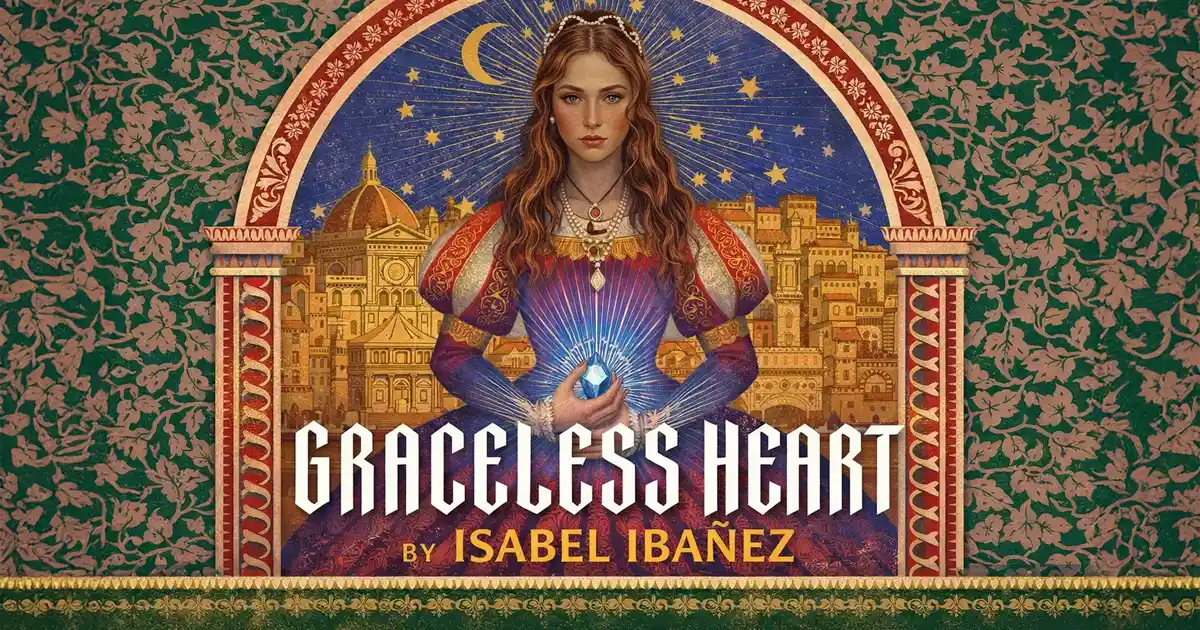
Isabel Ibañez's Graceless Heart is her adult debut, and it arrives with considerable anticipation. The #1 New York Times bestselling author of the Secrets of the Nile duology and Woven in Moonlight (named one of TIME's 100 Best Fantasy Books of All Time) has built a reputation for lush historical fantasy. This standalone promises Renaissance Italy, forbidden magic, immortal families, and political intrigue; a heady combination that delivers gorgeous atmosphere even as it stumbles in execution.

The Story
In 15th-century Volterra, Ravenna Maffei is a sculptress with a dangerous secret. In a world where magic is forbidden and women aren't meant to pursue art, she hides both her talent and the dark power that sometimes surges through her hands. When her brother is arrested for treason against the Medici, Ravenna enters a sculpting competition hosted by the mysterious Luni family; immortal beings who've offered an invaluable boon to the victor.
Ravenna wins. But instead of granting her wish, the Luni family kidnaps her, spiriting her away to Florence. There, she's forced into an impossible task: extract magical gemstones called Heartstones from beneath their estate, or face death at the hands of Saturnino dei Luni, the family's enigmatic and merciless heir.
But Ravenna's forbidden magic has drawn attention beyond the Luni household. Pope Sixtus IV, waging war against Florence, the Medici, and magic itself, sees her as a potential weapon. Caught between immortal families, religious persecution, and her own awakening power, Ravenna must navigate a world where everyone wants to use her; and where the cold, beautiful heir who threatens her life might be the only one she can trust.
What Works Brilliantly
The Setting
Renaissance Florence practically breathes off the page. Ibañez has clearly done extensive research, and it shows in every candlelit corridor, every description of art and architecture, every political machination between the Medici and the Pope. The novel incorporates real historical events; including the Pazzi Conspiracy; and features cameos from Leonardo da Vinci and Botticelli. For readers who love their fantasy grounded in rich historical detail, this setting is a genuine treat.
The author captures the era's contradictions beautifully: the flowering of art alongside religious persecution, the pursuit of beauty amidst brutal politics, the tension between humanism and faith. Florence becomes not just a backdrop but a character, its golden light and shadowed streets reflecting the moral ambiguity of everyone who walks them.
The Atmosphere
Ibañez excels at mood. The Luni manor feels appropriately gothic and dangerous, all beautiful surfaces hiding darker truths. There's a Crimson Peak quality to the proceedings; opulent decay, family secrets, and a heroine trapped in a gilded cage. Readers who enjoy atmospheric, immersive fantasy will find plenty to savour here.
The Concept
The combination of elements is genuinely fresh: Renaissance Italy, fae, witches, vampires (spelled "vampyres"), gemstone-based magic, the Catholic Church, and the Medici family's political machinations. It's ambitious worldbuilding that aims to weave real history with supernatural elements. When these threads come together, particularly in the novel's twistier moments, the result can be compelling.
The Art Connection
Ravenna's identity as a sculptress provides some lovely thematic resonance; the idea of shaping stone, of creating beauty from raw material, mirrors her journey of self-discovery. Sculpture becomes a metaphor for control, for taking chaos and giving it form. It's a thoughtful choice that sets this apart from the typical sword-wielding fantasy heroine.
What Doesn't Quite Work
The Pacing
At 488 pages, Graceless Heart often feels too long. The first half luxuriates in atmosphere and introduction at the expense of momentum. Many readers report hitting a wall around the 30% mark, where the story seems to spin its wheels. The political intrigue and character dynamics that should drive the narrative forward instead repeat similar beats, and the middle section drags considerably before the plot finally ignites in the final quarter.
The Romance
The enemies-to-lovers dynamic between Ravenna and Saturnino has all the right ingredients; tension, danger, forbidden attraction, moral conflict; but the execution is frustratingly uneven. Saturnino's feelings oscillate wildly between hostility and longing, sometimes within a single chapter. He's cold, then vulnerable, then threatening, then tender, in ways that feel less like complexity and more like inconsistency.
The chemistry, when it appears, flickers rather than burns. Many readers note that they were told about the attraction rather than made to feel it. The "I cannot have her but I must" dynamic is familiar territory, and Graceless Heart doesn't bring enough fresh perspective to make it sing. When the romance finally consummates, it arrives abruptly rather than as a satisfying culmination of built tension.
Character Agency
Ravenna starts promisingly; determined, sharp-tongued, willing to risk everything for her brother. But as the story progresses, she increasingly becomes a pawn moved between powerful factions rather than an agent of her own destiny. She's rescued repeatedly by male characters, her magic remains frustratingly underdeveloped, and her reactions to major revelations feel muted when they should be explosive.
For a novel that positions itself as featuring a strong female protagonist in a patriarchal world, Ravenna spends a surprising amount of time being acted upon rather than acting. Her sculpting, positioned as central to her identity, largely disappears after the opening competition.
Too Many Elements
The worldbuilding throws together fae, vampires, witches, immortal families, gemstone magic, and Catholic Church politics without fully integrating any of them. The magic system; based on different gemstones with different properties; is introduced but never deeply explored. The fae elements feel particularly underdeveloped, appearing more as flavouring than as fully realised worldbuilding. The result is a world that feels crowded rather than rich, its many elements competing for attention rather than supporting each other.
The Villain
Pope Sixtus IV serves as the novel's antagonist, but he's rendered in such one-dimensional strokes that it's difficult to take him seriously. Religious persecution of magic is a potentially fascinating theme, but the Pope's cartoonish villainy undermines any nuance the novel might have achieved.
The Verdict on Tropes
This book features:
Enemies to lovers (true hostility, not mild irritation)
Forced proximity
Immortal/mortal romance
Hidden magical powers
Kidnapped by powerful family
Political intrigue
Artist heroine
Brooding, morally grey love interest
Multiple POVs (including the villain)
Spice level: Open-door scenes (3-4, moderately explicit but brief)
Who Should Read This?
Perfect for readers who love:
Historical fantasy with real-world settings (Renaissance Italy)
Atmospheric, mood-driven storytelling
Political intrigue and family drama
The Familiar by Leigh Bardugo
Crimson Peak aesthetics
Art and artists in fantasy
Standalone romantasy (increasingly rare)
Consider carefully if you:
Need fast pacing and constant action
Prefer fully developed magic systems
Want a proactive heroine throughout
Are looking for swoony, well-developed romance
Dislike religious themes in fantasy
About the Author
Isabel Ibañez is a #1 New York Times, USA Today, Indie, and Sunday Times bestselling author. The daughter of Bolivian immigrants, she's known for bringing underrepresented cultures and historical periods to fantasy. Her debut Woven in Moonlight, inspired by Bolivian politics and folklore, is listed among TIME's 100 Best Fantasy Books of All Time. Other works include the Secrets of the Nile duology (What the River Knows, Where the Library Hides), Together We Burn, and Written in Starlight.
Graceless Heart marks her transition from YA to adult fantasy, and while the YA sensibility occasionally shows through, it represents an ambitious expansion of her storytelling scope.
Final Thoughts
Graceless Heart is a book of beautiful parts that don't quite cohere into a satisfying whole. The Renaissance Italian setting is genuinely gorgeous, the atmosphere appropriately gothic, and the ambition admirable. Ibañez writes lovely prose and clearly loves the history she's working with.
But the pacing issues are significant, the romance underwhelming despite promising ingredients, and Ravenna's journey from determined protagonist to frequently-rescued pawn disappointing. The novel wants to be many things; historical fiction, political thriller, dark romance, supernatural fantasy; and doesn't fully succeed at any of them.
For readers who prioritise atmosphere and setting above all else, Graceless Heart delivers. For those seeking tightly plotted romantasy with crackling chemistry and a heroine who drives her own story, this may prove frustrating. It's a book that's easier to admire than to love; much like, perhaps, the cold marble sculptures at its heart.