
"You have to be realistic about these things."
That line, repeated throughout Joe Abercrombie's First Law Trilogy, captures everything this series does differently. While other fantasy epics promise chosen ones and triumphant endings, Abercrombie delivers something far more uncomfortable: characters who are deeply flawed, a world that doesn't care about heroism, and an ending that will leave you staring at the wall questioning everything you thought you knew about fantasy fiction.
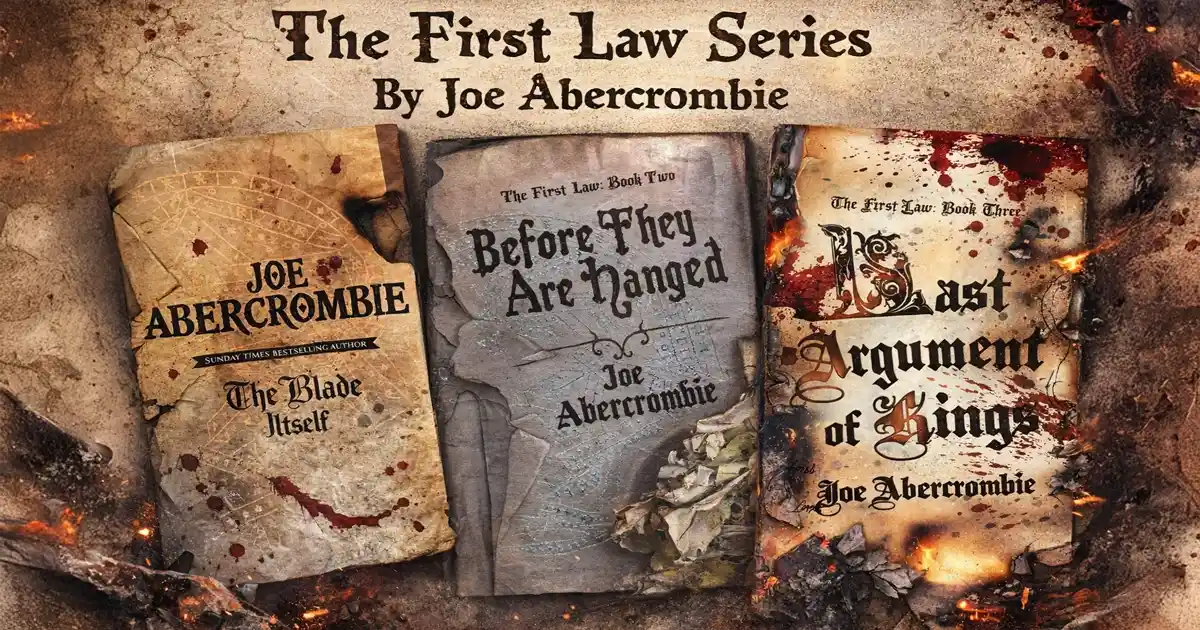
The First Law Trilogy — comprising The Blade Itself, Before They Are Hanged, and Last Argument of Kings — launched in 2006 and quickly became one of the most influential fantasy series of the modern era. George R.R. Martin called Abercrombie's work "bloody and relentless." Junot Díaz declared he'd written "the finest epic fantasy trilogy in recent memory." If you love morally complex characters and stories that subvert every expectation, this is essential reading.
What Is The First Law About?
The series is set in the Circle of the World, a realm loosely inspired by early modern Europe where magic is fading, politics is brutal, and war is constant. The Union — a sprawling empire with a dysfunctional government — faces threats from the barbarous Northmen in the frozen lands above and the mighty Gurkish Empire to the south. Caught in the middle are characters who couldn't care less about saving the world; they're just trying to survive it.
At the heart of everything is Bayaz, First of the Magi — a bald, ill-tempered wizard who may be the most powerful man alive or a spectacular fraud. He's manipulating events from the shadows, pulling together an unlikely group of people for reasons that won't become clear until the very end. And when they do become clear, you'll realise that everything you assumed about this story was wrong.
The Characters You'll Never Forget
Abercrombie's greatest strength is character work. The First Law features some of the most memorable, morally complex protagonists in fantasy — characters you'll root for despite knowing you probably shouldn't.
Logen Ninefingers
A legendary Northern warrior known as the Bloody-Nine, Logen has killed more men than winter. When we meet him, he's running from his violent past, hoping to become a better man. He's philosophical, surprisingly kind, and genuinely wants to change.
The problem is the Bloody-Nine — a berserker rage that transforms Logen into something monstrous, something that can't distinguish friend from enemy. Abercrombie plays a long game with Logen, presenting him as the most likeable character in the book before slowly revealing the full horror of what he's capable of. By the end, you'll be asking yourself whether a man can ever truly escape who he is.
Sand dan Glokta
A torturer with a dry wit and constant physical agony. Glokta was once the Union's most promising young swordsman — dashing, arrogant, beloved. Then he was captured by the Gurkish and spent two years in their torture chambers. He emerged a crippled wreck who can barely walk, can't eat solid food, and lives in perpetual pain.
So he became a torturer himself.
Glokta's internal monologue is darkly hilarious, offering cutting observations about everyone around him while simultaneously revealing his own self-loathing. He's a monster who knows he's a monster, and somehow Abercrombie makes you root for him anyway. His investigation into corruption in the Union provides much of the political intrigue, and his confrontations with power make for some of the trilogy's most memorable scenes.
Jezal dan Luthar
A vain, self-absorbed young nobleman training for a prestigious fencing tournament. Jezal is exactly the kind of chosen-one hero other fantasies would celebrate — handsome, talented, destined for greatness. Abercrombie uses him to skewer every trope about noble protagonists.
What makes Jezal fascinating is his character arc. He genuinely grows throughout the trilogy, becoming a better person through suffering and humiliation. And then the ending shows exactly how much that growth matters in a world controlled by forces beyond his understanding. It's devastating.
Bayaz, First of the Magi
The wizard who sets everything in motion. Bayaz presents himself as a mentor figure — think Gandalf with a worse temper — guiding our heroes toward some greater purpose. But something is deeply wrong with him. He's too convenient, too manipulative, too willing to sacrifice others for his goals.
The slow reveal of who Bayaz really is and what he actually wants is one of the trilogy's greatest achievements. By Last Argument of Kings, you'll understand why fans consider him one of fantasy's greatest villains — and he was supposedly on the heroes' side all along.
Book-by-Book Breakdown
The Blade Itself (2006)
The opening book introduces our characters and sets the pieces on the board. Logen meets Bayaz and travels south to Adua, the Union's capital. Glokta investigates corruption among the merchant guilds while navigating the dangerous politics of the Inquisition. Jezal trains for the Contest, a national fencing tournament, while falling for a woman far beneath his station.
The Blade Itself is primarily setup — it's less concerned with plot than with making you fall in love with these characters. The pacing is deliberate, the world-building immersive, and the humour wickedly dark. Don't expect resolution; this is the first third of a single massive story.
Before They Are Hanged (2007)
The middle book splits our characters across multiple fronts. Bayaz leads an expedition to the Edge of the World, seeking a weapon that could turn the tide of the coming war. Glokta is sent to defend the besieged city of Dagoska against the Gurkish. And in the frozen North, war has erupted between the Union and the Northmen under King Bethod.
The journey to the Edge of the World is where Logen, Jezal, and the bitter ex-slave Ferro are forced to confront who they really are. Meanwhile, Glokta's defence of Dagoska provides some of the series' tensest sequences. The middle book does exactly what middle books should: it develops characters, raises stakes, and sets up an explosive finale.
Last Argument of Kings (2008)
Everything converges. The wars reach their climax. Secrets are revealed. And Joe Abercrombie tears apart every expectation you had about how this story would end.
Last Argument of Kings features some of the best battle sequences in fantasy, particularly the brutal, chaotic clash where Logen fully becomes the Bloody-Nine. But the real power is in the aftermath — the revelations about Bayaz, the fates of characters you've grown to love, and the understanding that this world doesn't reward good intentions or personal growth.
The ending is bleak. Some readers hate it. But it's also thematically perfect — a story that promised to be realistic about violence, power, and human nature follows through on that promise completely.
Why The First Law Matters
The First Law Trilogy helped define grimdark fantasy as a subgenre. Before Abercrombie, fantasy largely operated on Tolkien's rules: good versus evil, heroes who triumph, endings that provide closure. Abercrombie (alongside writers like George R.R. Martin) demonstrated that fantasy could be morally ambiguous, politically complex, and brutally honest about the costs of violence.
More importantly, Abercrombie proved that darkness doesn't have to mean misery. The First Law is genuinely funny — Glokta's internal monologue alone is worth the read. The characters may be flawed, but they're also deeply human in ways that make you care about their fates even when those fates are terrible.
The series has since expanded significantly. Three standalone novels (Best Served Cold, The Heroes, and Red Country) explore the same world with different casts. The Age of Madness trilogy (A Little Hatred, The Trouble with Peace, The Wisdom of Crowds) continues the story a generation later. And a film adaptation of Best Served Cold is currently in development, with Rebecca Ferguson attached to star.
But it all starts here, with three books about a barbarian trying to change, a torturer trying to survive, and a wizard who might just be the villain of his own story.
Why You Should Read It
If You Love Morally Grey Characters
No one in The First Law is purely good or evil. Heroes do terrible things. Villains have understandable motivations. You'll find yourself rooting for a torturer and questioning whether the "good guys" are any better than the monsters they fight.
If You're Tired of Chosen One Stories
Jezal dan Luthar looks like a chosen one. Abercrombie spends three books demonstrating exactly how meaningless that is in a world where power belongs to those willing to take it by any means necessary.
If You Want Dark Humour With Your Fantasy
Glokta's sardonic observations. Logen's philosophical musings on violence. The absurdity of a world where everyone is too busy scheming to notice the apocalypse coming. The First Law is bleak, but it's also genuinely witty.
If You Love Excellent Action Sequences
Abercrombie writes some of the best combat in fantasy. The fights are visceral, tactical, and consequential — characters get hurt, make mistakes, and sometimes die. The battle sequences in Last Argument of Kings are particularly stunning.
If You Want to Start a Massive World
The First Law Trilogy is complete and satisfying on its own, but it's also the entry point to nine more books set in the same world. Once you're hooked, you have hundreds of hours of reading ahead.
Books in the Series
The Original Trilogy
The Blade Itself (2006)
Before They Are Hanged (2007)
Last Argument of Kings (2008)
Standalone Novels (Same World, New Characters)
Best Served Cold (2009)
The Heroes (2011)
Red Country (2012)
The Age of Madness Trilogy (Sequel Series)
A Little Hatred (2019)
The Trouble with Peace (2020)
The Wisdom of Crowds (2021)
Short Story Collections
Sharp Ends (2016)
The Great Change (And Other Lies) (2023)
Final Verdict
The First Law Trilogy is essential reading for any fantasy fan who wants more than simple good-versus-evil narratives. Joe Abercrombie crafted something special here: a series that's simultaneously a loving homage to fantasy traditions and a brutal deconstruction of them. The characters are unforgettable, the action is visceral, and the themes linger long after you've finished.
Just remember: you have to be realistic about these things.
Start with The Blade Itself. Clear your schedule. And prepare to have your expectations subverted at every turn.
Books Featured in This Article

The Blade Itself
by Joe Abercrombie
Inquisitor Glokta, a crippled and increasingly bitter relic of the last war, former fencing champion turned torturer extraordinaire, is trapped in a twisted and broken body - not that he allows it to distract him from his daily routine of torturing smugglers. Nobleman, dashing officer and would-be fencing champion Captain Jezal dan Luthar is living a life of ease by cheating his friends at cards. Vain, shallow, selfish and self-obsessed, the biggest blot on his horizon is having to get out of bed in the morning to train with obsessive and boring old men. And Logen Ninefingers, an infamous warrior with a bloody past, is about to wake up in a hole in the snow with plans to settle a blood feud with Bethod, the new King of the Northmen, once and for all - ideally by running away from it. But as he's discovering, old habits die really, really hard indeed... ...especially when Bayaz gets involved. A bald old man with a terrible temper and a pathetic assistant, he could be the First of the Magi, he could be a spectacular fraud, but whatever he is, he's about to make the lives of Glotka, Jezal and Logen a whole lot more difficult...

Before They Are Hanged
by Joe Abercrombie
The second novel in the wildly popular First Law Trilogy from New York Times bestseller Joe Abercrombie. Superior Glokta has a problem. How do you defend a city surrounded by enemies and riddled with traitors, when your allies can by no means be trusted, and your predecessor vanished without a trace? It's enough to make a torturer want to run -- if he could even walk without a stick. Northmen have spilled over the border of Angland and are spreading fire and death across the frozen country. Crown Prince Ladisla is poised to drive them back and win undying glory. There is only one problem -- he commands the worst-armed, worst-trained, worst-led army in the world. And Bayaz, the First of the Magi, is leading a party of bold adventurers on a perilous mission through the ruins of the past. The most hated woman in the South, the most feared man in the North, and the most selfish boy in the Union make a strange alliance, but a deadly one. They might even stand a chance of saving mankind from the Eaters -- if they didn't hate each other quite so much. Ancient secrets will be uncovered. Bloody battles will be won and lost. Bitter enemies will be forgiven -- but not before they are hanged. First Law TrilogyThe Blade ItselfBefore They Are HangedLast Argument of KingsFor more from Joe Abercrombie, check out:Novels in the First Law worldBest Served ColdThe HeroesRed Country

Last Argument of Kings
by Joe Abercrombie
The end is coming. Logen Ninefingers might only have one more fight in him - but it's going to be a big one. Battle rages across the North, the King of the Northmen still stands firm, and there's only one man who can stop him. His oldest friend, and his oldest enemy. It's past time for the Bloody-Nine to come home. With too many masters and too little time, Superior Glokta is fighting a different kind of war. A secret struggle in which no-one is safe, and no-one can be trusted. His days with a sword are far behind him. It's a good thing blackmail, threats and torture still work well enough. Jezal dan Luthar has decided that winning glory is far too painful, and turned his back on soldiering for a simple life with the woman he loves. But love can be painful too, and glory has a nasty habit of creeping up on a man when he least expects it. While the King of the Union lies on his deathbead, the peasants revolt and the nobles scramble to steal his crown. No-one believes that the shadow of war is falling across the very heart of the Union. The First of the Magi has a plan to save the world, as he always does. But there are risks. There is no risk more terrible, after all, than to break the First Law...